
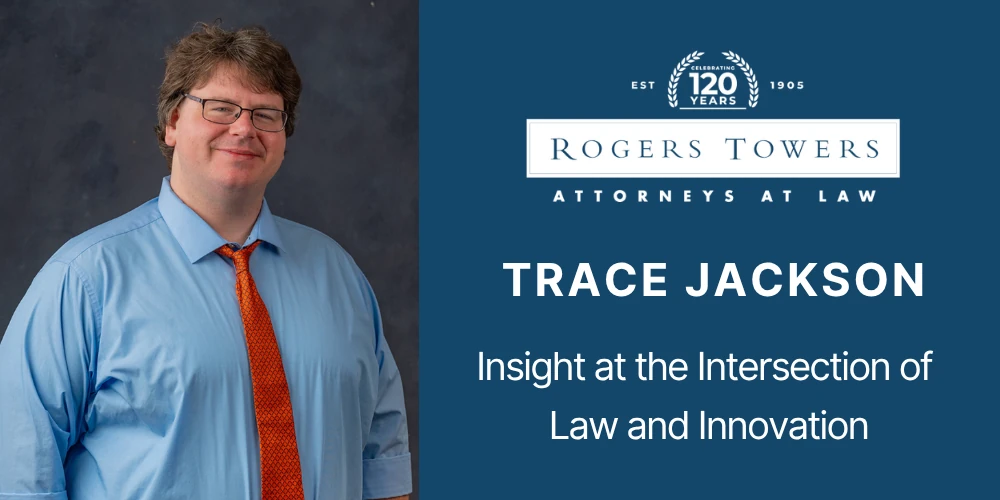
Trace Jackson occupies a distinctive space at the intersection of law, technology, and business. As part of Rogers Towers’ transactional team, he brings deep expertise in intellectual property, emerging technologies, and artificial intelligence, paired with the ability to translate complex technical and legal concepts into actionable guidance for clients. In an era where technology is central to business operations and deal-making, Trace’s insight allows clients to understand both the strategic opportunities and the potential risks inherent in technology-driven transactions.
Jason P. Rudderman, who works closely with Trace, describes him as “probably the smartest person in most buildings. He can tell you the legal side. He can tell you how the software works, too.” That combination of legal acumen and technical fluency positions Trace to address increasingly sophisticated questions around IP, software, and AI that arise in modern transactions. Whether evaluating a licensing agreement, analyzing proprietary software architecture, or considering the implications of AI-generated content, Trace provides clarity and practical guidance grounded in both law and technology.
Trace’s academic background in mathematics and physics underpins his analytical approach. Unlike lawyers who focus primarily on contract language, Trace can evaluate the technical foundations of a business, assessing the systems, algorithms, and software that often constitute its core value. This depth of understanding is particularly critical as AI tools are increasingly used in transactions for due diligence, document review, and risk assessment. Trace ensures that clients understand both the potential efficiencies AI offers and its limitations, particularly in protecting confidentiality and safeguarding sensitive data.
“He’s really embraced the AI developments,” Jason notes. “He’s great at synthesizing what’s out there and delivering it in a non-techie, business-friendly way. That’s a pretty unique talent.” Trace’s ability to communicate technical complexity in accessible language allows clients—whether corporate executives, business owners, or other stakeholders—to make informed decisions without being overwhelmed by jargon or technical detail. His guidance helps clients evaluate risk, anticipate issues, and structure transactions to protect valuable assets while enabling strategic growth.
AI is reshaping transactional processes in several ways. Buyers are increasingly using AI tools to streamline contract review, organize diligence materials, and identify potential risks, while sellers are focused on confidentiality, data security, and appropriate use of proprietary technology. Trace helps clients navigate this evolving landscape, ensuring that technology is a tool to enhance judgment, not replace it.
“Buyers want to use it for due diligence,” Jason explains. “We have concerns about confidentiality and how it’s being used. It can be helpful in organizing thoughts and streamlining diligence. We’re going to find efficiencies in due diligence and drafting, but sophisticated clients are not ready to eliminate human oversight.” Trace’s perspective emphasizes the balance between technological efficiency and human expertise—ensuring that key decisions reflect strategic judgment, not just data processing.
Within Rogers Towers, Trace functions as both a technical resource and a strategic advisor. His insights inform negotiation strategy, diligence priorities, and risk assessment, particularly in transactions where software, IP, and AI are central. Colleagues describe him as a collaborator whose perspective elevates the firm’s capacity to handle complex deals with confidence and precision. By combining technical fluency with legal strategy, Trace provides measurable value to clients navigating sophisticated, tech-driven transactions.
Trace also extends his thought leadership through his role as an adjunct professor at Jacksonville University, where he teaches courses in intellectual property and technology law. “Teaching keeps me sharp,” he says. “It forces me to think about how to translate technical and legal complexity into concepts that are understandable and practical for students—and that skill directly benefits my clients.” His academic role reinforces his credibility, keeps him at the forefront of emerging legal and technical trends, and allows him to mentor the next generation of lawyers in a rapidly evolving field. His academic experience is complemented by national speaking engagements on artificial intelligence and emerging technologies, including presentations at MIT and the University of Florida, as well as local organizations such as Rotary Clubs.
Clients benefit from Trace’s methodical and holistic approach, particularly when assessing IP portfolios, licensing arrangements, or AI-driven assets. By combining deep technical knowledge, practical legal insight, and clear communication, he ensures clients fully understand both the opportunities and potential pitfalls in each transaction. His guidance allows organizations to protect critical assets, structure deals effectively, and anticipate challenges before they arise.
Jason emphasizes that Trace’s contribution extends beyond tech-specific transactions. “His ability to synthesize complex issues and present them in a business-friendly way adds value across the transactional practice. That’s what makes him stand out,” he notes. Whether a deal involves traditional M&A, IP licensing, or emerging technology, Trace provides clarity, foresight, and strategic perspective at every stage.
Trace Jackson exemplifies a modern transactional lawyer—one who blends legal expertise, technical depth, and pedagogical insight to guide clients through complex, tech-driven transactions. His work ensures that AI, software, and IP considerations are fully integrated into strategic decision-making, allowing clients to act with confidence and precision. For businesses navigating technology-driven deals, Trace’s expertise provides a rare combination of rigor, insight, and clarity that is increasingly essential in today’s market.