
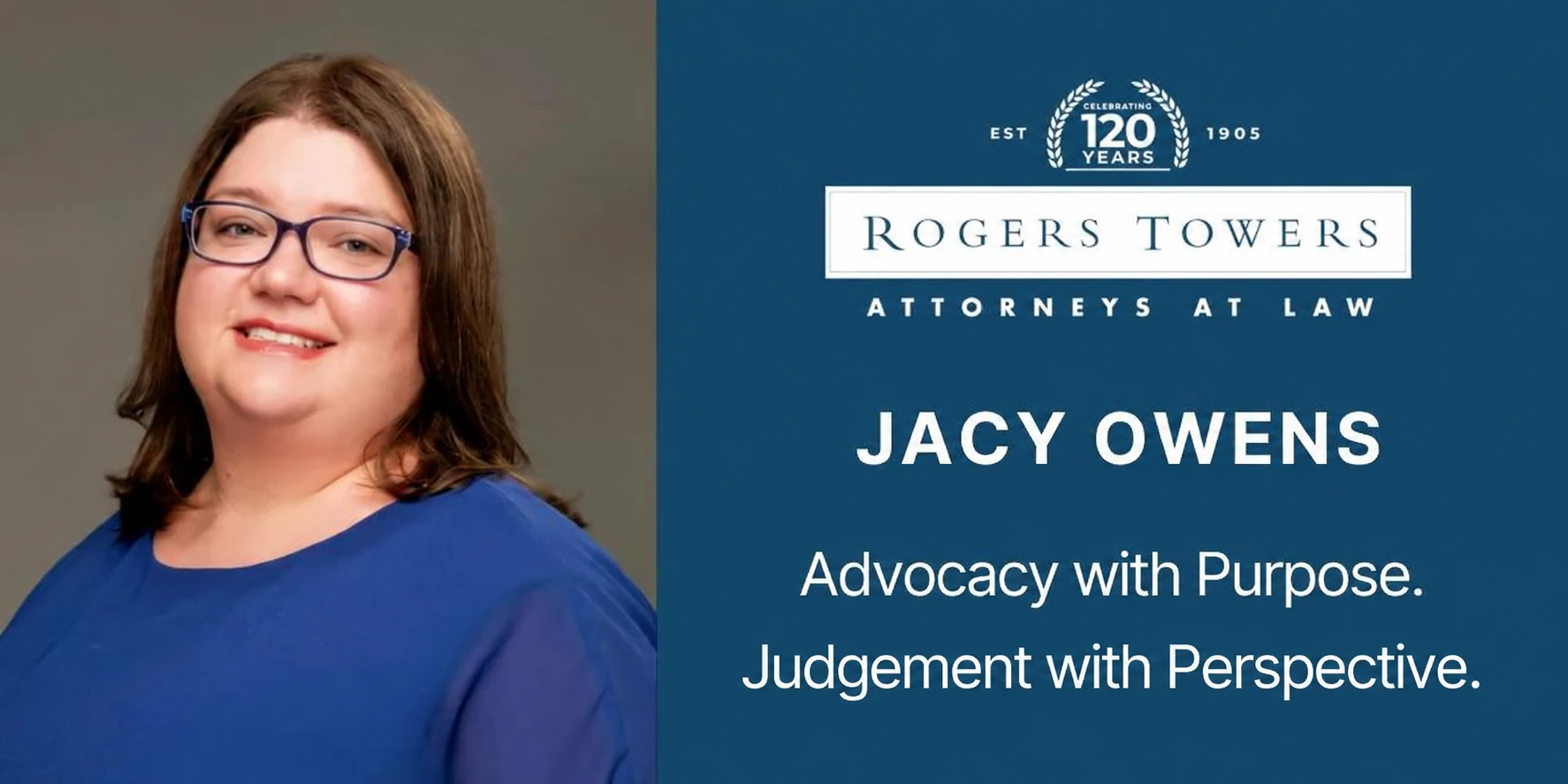
For Jacy Owens, becoming a Shareholder in the Litigation Department reflects both a professional milestone and an expanded sense of responsibility. After years of developing her practice, the role marks a transition toward helping shape the strength of the department while continuing to guide clients through complex disputes.
“Becoming a Shareholder represents a lot of years of work and growth, but it also represents responsibility — responsibility to the firm, to our clients, and to the younger attorneys coming up behind us,” Owens says. “At this stage in my career, it’s not just about my own practice anymore. It’s also about helping contribute to the strength of the team and the firm as a whole.”
Owens was drawn to litigation early in her career for its strategic nature and the intellectual challenge it presents. Each case, she notes, requires careful evaluation of facts, law, and timing, with decisions often unfolding under significant pressure.
“What drew me to litigation initially was the strategy behind it — every case is different, and you’re constantly evaluating how to approach a problem,” she says. “I realized early on that I enjoyed the challenge of it — the analysis, the advocacy, and helping clients navigate situations that can be very complex and very stressful.”
Today, Owens’ practice focuses on complex litigation matters involving hospitals, businesses, and individuals across a range of industries. Many of the disputes she handles involve significant financial, operational, or reputational stakes, requiring a combination of strong advocacy and practical judgement.
“My practice today is focused on complex litigation matters involving hospitals, businesses, and individuals across a range of industries,” Owens says. “Each case brings different challenges, but the goal is always the same — to advocate for the client while keeping their long-term objectives in mind.”
Those long-term objectives often become the focus of the earliest conversations she has with clients. When someone comes to her facing a significant dispute, Owens prioritizes understanding not only the facts of the matter but also what the client ultimately hopes to achieve.
“The first priority is understanding the full picture — not just the facts of the dispute, but what the client ultimately wants to achieve,” she explains. “It’s important early on to talk through strategy and expectations so that the client understands what the path forward might look like.”
Litigation can place significant pressure on clients, particularly when the outcome may affect a business, professional reputation, or personal interests. Owens approaches those situations by combining strategic focus with steady communication.
“Litigation can be very stressful for clients, especially when the outcome has a significant impact on their business or their reputation,” she says. “Part of my role is helping them stay focused on the bigger picture while also making sure they feel informed and supported throughout the process.”
Developing that broader perspective is also central to determining how a case should be handled. Owens approaches litigation strategy with a pragmatic mindset, recognizing that not every dispute requires the same posture.
“Every case requires a different strategy,” she says. “Sometimes an aggressive approach is necessary, and other times the best outcome for the client comes from pursuing resolution. The key is always evaluating what approach will ultimately serve the client’s interests best.”
Part of that evaluation involves helping clients understand the realities of the litigation process itself. Many people, Owens notes, assume disputes will move quickly or follow a predictable path through the courts.
“One common misconception is that litigation will move quickly or follow a very predictable path,” she says. “Part of my role is helping clients understand the process and setting realistic expectations from the start.”
By addressing those expectations early, she helps clients approach the process with a clearer understanding of the timing, complexity, and decision points that may arise along the way.
Owens’ experience representing hospitals, businesses, and individuals across multiple industries also shapes how she approaches new disputes. Exposure to different regulatory environments and business structures allows her to understand the broader context in which a conflict arises.
“Working with clients across different industries gives you perspective on how different businesses operate and what their priorities are,” she says. “That experience helps you approach each case with a broader understanding of what the client is facing.”
Within the firm, Owens also points to the value of working alongside attorneys across multiple practice areas. Complex disputes frequently involve issues that extend beyond traditional litigation, touching on areas such as regulatory compliance, employment matters, or corporate governance.
“One of the strengths of Rogers Towers is the depth of experience across practice areas,” she says. “In litigation, issues often overlap with other areas of law, and being able to collaborate internally allows us to provide more complete guidance to our clients.”
Looking ahead, Owens expects litigation to remain both challenging and rewarding precisely because no two cases follow the same path. Each new matter brings its own set of facts, personalities, and strategic considerations.
“Litigation is challenging because no two cases are exactly the same,” she says. “What keeps it meaningful is the opportunity to help clients navigate difficult situations and work toward the best possible outcome.”
As she continues building her practice as a Shareholder, Owens sees her role as balancing that work with a broader commitment to the firm—contributing to the development of younger attorneys while helping strengthen the litigation team as a whole.